Wednesday, 2 January 2019

A Place of our own at last! (well, partly)

When we moved into Marine Gate Mansions we thought it might take us a year or  so to find something that suited our budget. Our palatial residence  in the old Southport hospital, converted into luxury flats, was meant to last a year. Then we'd be sensible and find something more sustainable.

Perusing the Rightmove site, I discovered Housing Associations. Not that we didn't know about them before, but assumed they'd been disbanded, as with  the one where we lived in SE London,  in the eighties. They offer joint ownership deals, so we could afford to buy in one of their properties for the over-60s, only a block away from Marine Gate Mansions.

Two previous attempts to buy fell through, but success at last! Almost two years from when we came to Southport, I collected the keys to a flat in Sunnyside Court last Monday. All set for some renovations, and measuring up is under way.

Flash Forward to Jan 2019 


Writing now, from Playablanca, Lanzarote,  at the start of 2019, it all seems to have flashed by, of course. My New Year Resolution is to keep up my blog. See how I go. Only 9 days to go before our return to Car Park View. Looking forward to our next year in Southport, which I hope will be less about settling in. 

Friday, 17 June 2016

Southport Skies


There's very little not to like about Southport, but the sky is one of its  best features. Perhaps that's not so  surprising in a town that faces westwards over  a flat coastline. This photo was taken at the end of the pier on a misty Winter's day. It's well known, I think, that the sea rarely comes in at Southport, so it  always has a feeling of  tranquillity.

No wonder the highlight of the year's events is the Air Show, something that took place just after we arrived in September. The planes do their flypast over the beach, where visitors pay to be within earshot of a commentary. But they can be seen from any point along the Promenade, and from  Lord Street as they circle back over the town.

T

Even inland skies are impressive,  as in the photo below, showing  the war memorial  in Lord Street at dusk. The setting sun lights the edge of a massive  cumulus  cloud, so it looks like a bolt of lightning and  reflections in  wet pavements  add a touch of glamour to the atmosphere. 


When we came last September we were lucky enough to find a flat that overlooked the Marine Lake , on the Promenade. The rent's too high  for us to live in such a splendid building for long, but for a while it's a chance to view amazing sunsets.

Built around 1860 as a  hospital and convalescent home for workers affected by the cotton famine created by the American Civil War, the building  became an NHS hospital and was converted into flats in the 1990s.  The  photo below was taken from the opposite side of the Promenade, when the clouds rolling in from the North West created a light that deepened the redness of the Victorian brickwork.


On the same  Winter evening, clouds that mostly turn pink and gold at sunset  float high above the glow in dark,  ghostly shapes.  The photo below looks over the Marine Lake from the carpark of the Lakeside Inn, which claims to be the smallest pub in England.  An old pleasure steamer is permantly  moored there, which always makes  think of the Hollywood film Showboat, set on the Mississippi.


Sunday, 28 February 2016

As You Like It by William Shakespeare at The Atkinson


I thoroughly understand why 'As you Like It' has not been staged at the National Theatre for 30 years. It has too many characters and a confusing  plot. However, it includes one of the playwright's most oft-quoted passages, the so-called 'Seven Ages of  Man' speech, beginning 'All the world's the stage' , as well as some familiar gems such as Touchstone's (Mark Benton)  description of his rustic girl-friend: 'An ill-favoured thing, but mine own'.

It was a real treat to see an RSC production streamed live on Thursday at the Atkinson in Southport, not least because it's only a fifteen minute walk from where I live.

This wasn't a production to change my view of the play,  but it was very entertaining - maybe not for the right reasons.

Set in the Forest of Arden, the action consists  of the interactions of  a number of  lovelorn and mistreated characters as they drift in and out of a 'clearing' , narrowly missing one another, much like the 'another part of the battlefield' convention of 'Macbeth' and 'Henry V'. The twist here is that they emerge from between the  'branches' of  dangling furniture.

It takes a stage with the capabilities of the Olivier to transform a 'Pyjama Game'-style  workshop into a forest. It was like watching  a slow-motion  explosion in an IKEA warehouse. Hinged chairs, tables and and desk-lamps remain suspended at different levels, spotlights piercing the gloom in a permanent winter twilight. Rehearsals must have been a nightmare.

The forest , like the air of Prospero's island, is full of strange sounds - made by actors concealed in the misty branches, who  hoot and howl and act as backing for the songs . The cast list describes them as 'Choir'. When all the charactes are rightfully matched and the mood change from the chill of man's cruelty to the celebration of love, they come into their own. It's  hard to imagine a more distracting and at the same time a more coherent setting for such a fragmented play.

All the lead performances were good, from the breathless Rosalind(Rosalie Craig)  dressed as a man and a quirky Amelie-riff Celia (Patsy Ferran) to Paul Chahidi's Oscar Wilde-inspired Jaques.

Comic relief was provided by hero Orlando's contest  with Charles, the Duke's wrestling champion,  given the huge disparity of size between the contestants, and a very funny later scene with various  members  dressed in Aran sweaters  on all fours, proving that even sheep can be imbued with  individual characters.


Monday, 8 February 2016

A Dragon Dance in Manchester


I thought I’d do less gadding about in Southport, but with three cities nearby, the opposite seems to be  true.
,

When Radio Lancashire announced Chinese New Year Celebrations in Manchester would  take place at  the weekend, I decided to head to  Albert Square on Sunday afternoon. Roy, who seems to like walking about in northern  rain after all, was happy to accompany me.

I love a good dragon dance – as colourful as Chinese opera,  but shorter and more exciting. The technique’s similar to the that demonstrated  in the stage version of War Horse: well-managed poles  and precise  team work are of the essence.

 Still images do little justice to the spectacle of the rippling, glittery  huge-headed dragon  as it advances and recoils. It nearly  doubles back on itself as it wends its way behind the fan-waving women . Almost as important is loud accompaniment of  drums and clashing cymbals.

There’ll be plenty more gadding about -  this was an auspicious  start to the year of the monkey

Thursday, 4 February 2016

A Trip to Wigan


For years I've written  occasional play reviews for a website called Remotegoat (don't ask me about the name - I must find out sometime). I don't get paid, but there's two free tickets and a programme in it for me, with drinks and snacks  if I review on a press night.

On average it take me about three hours to research and write about the performance next morning. I look up the play if I don't know it, (the Samuel French website is useful), plus background  on the  company and the actors.

'Curtain up on Murder' last night was the first play I've reviewed for over a year - another writing activity that moving to Southport interfered with.

It was on in Wigan, a town I haven't been to before but which is only half an hour on the train from Southport.

I'd heard of Wigan Pier as some kind of tourist attraction, and  I persuaded my partner to go early so we could visit. Sadly, although we went down to the canal-side site,  it was derelict . Even the nearby mill called Trencherfield only opens to vistors on Sunday.

Wigan has a pleasant market square but it was too cold to linger. We went into a shopping centre where we read in the Costa until it was time to eat in a local restaurant, picked from TripAdvisor on Google. It was a good choice, called Thai Corner, and our only regret was we didn't have more time to linger over the excellent food.

Thanks to Google maps we found the venue , St Michaels Hall, in a back street. The show was a most enjoyable spoof murder mystery. I posted my review to the  Remotegoat website this morning.

Wednesday, 3 February 2016

Victorian Dreamers


This small but almost perfectly formed exhibition draws on the Atkinson's own stock of beautifully restored Victorian art.  Mostly 'escapist' in an age of social anxiety, it  looks at the themes of travel,  storytelling, the antique past and nature to show a Victorian love for an idealised past that probably never existed. 


Ceramic  figurines, familiar from  antique shops and stately homes and the paintings of Highland cattle in natural landscapes depict areas of desirable retreat for the wealthy, then as now.


Working people are depicted as respectful , contentedly labouring in picturesque rural landscapes or praying in simple domestic interiors: comforting images in  an increasingly mechanised age. 


My favourite piece is this Wedgewood depiction of a classical scene by Camillo Pacetti, first made in Rome in 1790 : after the fall of Troy, Priam appeals to Achilles for  the return of  his son Hector's Body .


Victorian artists were restricted to  classical or biblical themes in their depiction of nude figures,  as in Ernest Normand's striking 1986 portrait of Pygmalion and Galatea at the moment when the statue comes to life and  John Collier's 1892  painting of a snake-entwined Lilith  as she plots to depose her rival, Eve,  in the Garden of Eden.


If the gilt frames and chocolate-box images have an air of unreality,  they had a lasting effect on  the national sensibility. Present-day politicians who retreat to  country mansions  after advocating hard work and thrift to  the working population,  our daily dose of The Archers on BBC radio and the justifying  of social inequality are all  part of the Victorian legacy,  as this exhibition reminds us.

Thursday, 2 July 2015

Where there's muck...


'Remember what Quentin Crisp said about house dust'  - it doesn't get any worse after the first five years!'   Appropriate  as it was in 'Pride' week to be reminded of a splendid  1970s gay icon,  here in Lewisham we  seem to have had five years dust in as many months. So my husband's words didn't bring much comfort.

It's not just ordinary dust, either -it's a brownish gritty coating that sticks to  sills and furniture and irritates eyes and throats.

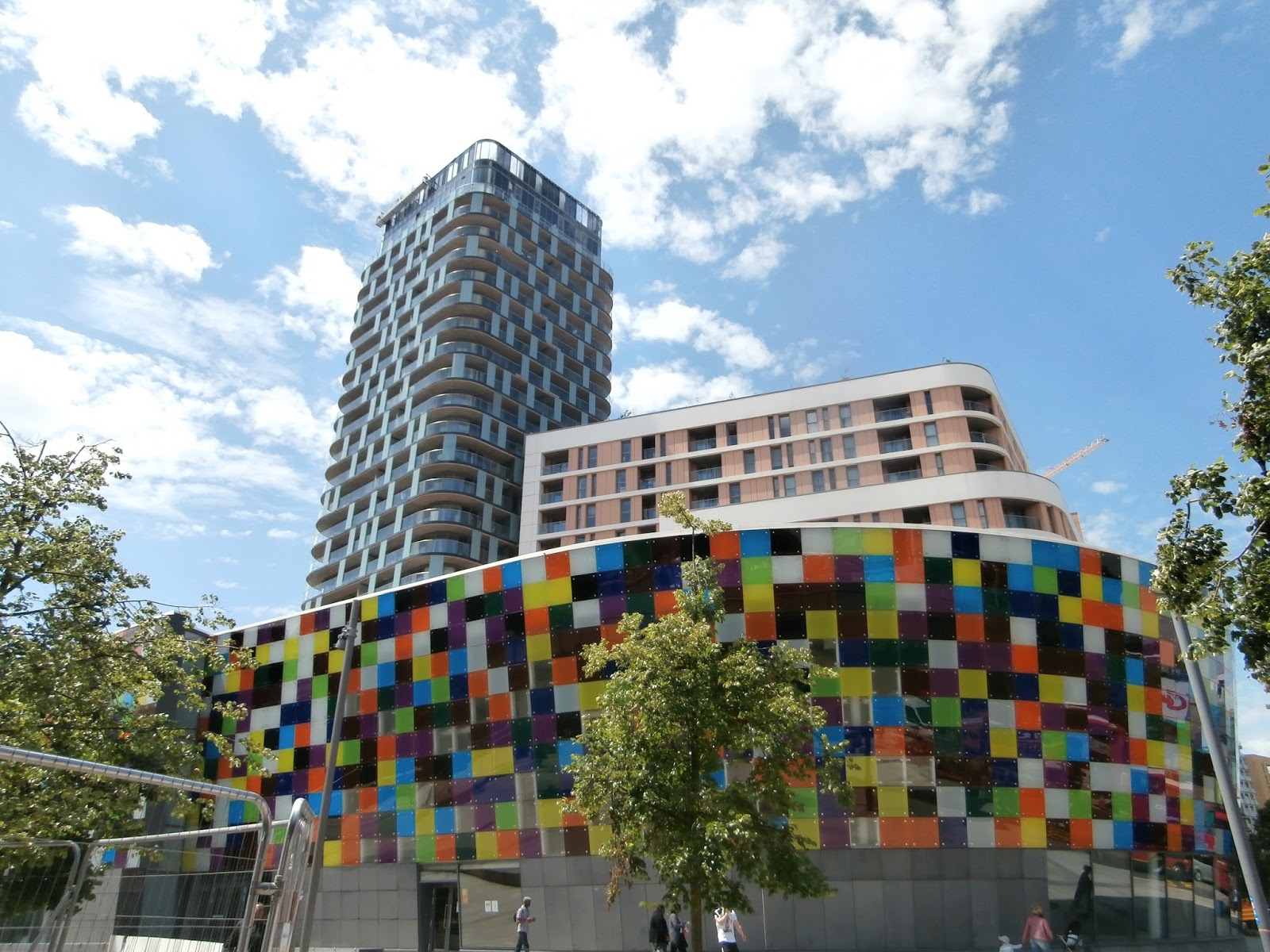
I'm a bit slow to connect things at times but it didn't take a genius to work out that all the extra air pollution is connected to the extensive construction work that's turned  the area into one vast building site. For months we've woken to the sound of pile-drivers gouging pits for the foundations of 22-storey blocks of flats and offices, diverting rivers  and delivering 'retail outlets' .


There's been plenty of building at the High Street end of the road since we arrived in 1994: a home for the elderly (left in the photo) instead of a coal yard;  a small-scale municipal estate on the other side,  an Adult Education College so ugly that the council tenants got up a petition, and, most recently, a Premier Inn where the  carwash used to be. It's the sort of development that, spread over a few years, is relatively harmless.

It was clear the grandly-named 'Domus' was unfit for purpose - dementia isn't improved by the rattle of trains passing every five minutes, so now it's an admin building. The Premier Inn project  has been stalled for weeks,  probably for the same reason.

 
The bottom of the hill hints at the disruption - the removal of a roundabout and the  re-routing of an urban stream, to build a town centre fit for heroes.
 
 
In place of   a roundabout  now there's a complicated rerouting that brings hold-ups and traffic mayhem .


The pavement has becomes  a bridle path where the hoarding round the  Premier Inn  sticks out;  even the police horses seems confused. Towering above it all is a an abandoned branch of Citibank. Here  I admit to a personal grudge -it stands between y TV aerial and the transmission tower at Crystal Palace. For us, it meant, 'Hello, Sky TV' 


The centre's relatively unscathed, although they moved the clock tower several feet a few years ago.


There's been some benefits, including the new Glass Mills Leisure Centre, which opened last year. Free swimming for under-sixteens and over-60s. I take full advantage, despite the problems due to bad management.
 

But nearby  is the villain of the piece - or the saviour, depending on your point of view,  and the state of your lungs. In the early 1990s the Docklands  Light Railway (DLR) connected Lewisham to Canary Wharf and Bank  stations. Understandably, the council is keen to make a profit from new residents and services. Hence the frenzy of construction work to provide homes and facilities for our modern financial heroes.

The whole regeneration scheme won't be complete until 2018, when
Lewisham will in effect become a dormitory  for commuters.

It'll be interesting to see the results of it all -if the drawings on the hoardings are any indication, it will confound the critics. My neighbour says he's waiting to profit from the sale of his flat when the Bakerloo Line extension adds to the chaos.  I hope by then to be breathing clean air at the seaside and testing out Quentin's theory.

Sunday, 14 June 2015

Penge was my Paris


Early Poster for 'La Boheme'

A live cinema broadcast of 'La Boheme' last week reminded why I wanted to live in London and why I left Preston when I was seventeen. It took a few years to get here, but I knew where I was going.

'Heaven must be full of  Prestonians', a friend had exclaimed, at her first sight  of the skyline in my home-town. It certainly  had more than its fair share of spires and towers - not to mention factory chimneys. But by the  age of seventeen I was bored with the skyline, the streets full  of workers' houses, and the soot-blackened Victorian town centre.

It was a restless time, what with the  new freedoms of the late fifties, Harold  MacMillan telling us we'd never had it so good and  social change reflected in films and plays, full employment and the invention of 'teenagers'; not to mention a constant soundtrack  of Beatles and Beach Boys.

The northern  protagonists of  the films and plays usually remained stuck where they started and in any case  their ambitions didn't  extend beyond fancy clothes and flashy cars. In the  age of 'Room at the Top', my head of department lent me the Bond books one by one. Although I read them avidly, I didn't share her enthusiasm for the hero. His liking for cocktails and casinos didn't interest me. Instead, I saw foreign films in Manchester on payday weekends

The Harris Library and Museum in Preston
 
  But it was Zola that was mainly to blame. I'd  spotted  a bookcase labelled 'Classics' in the Harris Library, where Jane Austen, Trollope and Dickens rubbed spines with  foreign novels in translation. For weeks I was fascinated by  Dostoyevsky and Hamsun. But  it was the French fiction  especially Hugo and Zola, that  had me in thrall. I couldn't get enough of all those men and women with their restless souls and lofty ideal.  In short, I glimpsed  there  was more to life than an NHS office and evenings at Young Socialists meetings or amateur dramatics at the Co-op Hall.

If only I could live in a big city, like Paris, I'd meet like-minded people and my life would be transformed. 

If I couldn't make Paris, London would do. Hence the conversation I had a few  years later with my husband.  By then we had two young children -it seemed sensible to get motherhood out of the way before I started  - and he'd secured a post as Lecturer in London,  where I hoped to study for a degree. I had very little idea of the city's geography other than what I'd glimpsed on CND marches and one or two weekends spent commuting between a Youth Hostel in Holland Park and West End cinemas.

'Penge! You spend three days in London looking for a flat and you come up with somewhere I've never heard of!'

I felt a bit better when I'd pored over the map and I saw that while Penge  might be nowhere near Bloomsbury it was at least adjacent to Crystal Palace, which I had heard of.

But going to London did transform my life and opened up all kinds of opportunities. To  all intents and purposes,  Penge became  my Paris.


Thursday, 28 May 2015

Moving the Earth


Photo taken on the walkway outside my flat c. 1995, when younger sister Carol was on a visit from Australia


 Some people to take the contents of their gardens with them when they move. Apparently,  it's not uncommon to do this on a large scale.

As a flat dweller whose garden is in pots, I don't have that option. Quite apart from my 'start again' mentality, the plants would die in  storage  while we look for a new place. All the same, there's  a fair amount of spade, or rather trowel, work involved. Instead of assuming that the new tenants will want to look after my current crop of neglected geraniums I've decide to throw,  or give,  them away and leave the walkway free of clutter.


What to do with the earth from the plant pots was a question that
troubled me for a while The council sell garden bags for £10, I was told, and you leave them out for collection,  but how many were obtained for that amount I wasn't sure. Then my neighbour at Flat 5, who does the general gardening, said to throw the earth on a bank beside the garage block. Problem solved.


A  more interesting challenge is the collection of rocks on the back balcony. Ten years ago -can it be ten years?- I agreed to take charge of a rock collection  belonging to a Singaporean friend, a Mandarin tutor at Westminster University.(I'd known her some years because the part-time evening degree tended to drag on at my extremely slow rate of progress) She was moving at the time into a rented flat in North London and there wouldn't be room for them in her new digs. So I loaded them into my car and drove them South.  They may not look much in the photo, but they glisten and show off their markings when it rains. Now that L has a flat of her own we can meet up for lunch in Chinatown and effect a handover. Might take two trips with my shopping trolley, as I no longer have a car.


Unfortunately,  a number of the rocks have already disappeared. Every five years or the balcony floor is re-covered in bitumen as part of a refurb, and the last time I wasn't vigilant enough to stop a workman from helping himself to a few. What's the point of stealing rocks, you might ask, but these are no ordinary rocks. It's obvious from the photo that they are all very different, and indeed they were collected over a number of years from beaches and hillsides my friend had passed on her travels.  I hope she'll be so delighted to be reunited with them that she won't miss the ones that are gone.

The relationship the Chinese have with rocks is a bit mysterious, to Western ways of thinking, and  I'd certainly noticed that their ideas about gardens are different. Instead of a lawn and flower beds and maybe a few decorative bean rows and cloches, the Chinese like rocks - the older and more bizarrely shaped the better. Ideally they should resemble mythic creatures like turtles or dragons. Add some carp ponds with water lilies and a little bridge, a pagoda and some willows, and it's complete.

The domestic ones, as distinct from the tourist magnets you can visit in places like Shanghai and Suzhou, are of course on a smaller scale. But I  suspect they are less inclined to leave with their owners on removal day.

Thursday, 21 May 2015

Driven to Distraction


I do like novelty and change, so that aspect of relocating doesn't bother me, apart from the odd twinge of regret. I'll miss family and friends but these days it's easy to keep in touch.  I know that better than most because my family and friends are scattered around the globe. We'll be able to come and go by train easily enough to see the grandchildren in London or have them visit our new seaside home.

What does bother me is all the uncertainty connected with selling the flat. I'd expected not to be here by Election day, for instance, so had arranged postal votes for Roy and self.  Then I was cross when it came and went, because I like all the palaver of going to vote in person.

The main  area of uncertainty just now is whether to call it quits with our very dilatory buyer and to put the flat back on the market. But that would mean  the prospect of more viewers to tidy up and wait in for. And no guarantee that the next one wouldn't be just as slow. I'm subjected to conflicting advice,  but whenever I'm urged to take a stricter line at the latest setback there's always Roy to tell me to curb my impatience.

Then it hit me all of a sudden last weekend - I could learn Greek! Maybe I found the box when I was sifting through the charity-shop donations.

I already have this  set of book and two disks because we went to Cyprus for the first time last October. At that time it was all a bit short-notice and I didn't have the concentration, following a death in the family. Now, with further  travel a possibility, it seems a perfect distraction.

It's a good course, all clearly set out with tasks to do each day , flash cards to carry around on the transport and mentions of exotic places  in the dialogues. 

It's not just the formality of language learning that appeals, either. True, I like the way the nouns and adjectives all fit together with their different endings, the lists of vocabulary and the carefully constructed conversations. I'm also excited at the chance  know more about the culture. I've even bought a box set about Ancient Greece.

Mostly, though, it's a comfort to be in charge and to have a sense of progress. It may seem a bit extreme, but for me it's a perfect distraction.


Tuesday, 19 May 2015

After the London Eye


Last Wednesday's glorious weather  prompted a trip on the London Eye with my granddaughter. The green Thames glittered below and all the buildings, from familiar  St Pauls, Big Ben and the Houses of Parliament, to the newer  the Shard and Gherkin, sparkled in the sunlight.


An  unexpected reaction to a view of the whole city laid below was one of nostalgia and regret. How could I leave all this behind?

I even put it to my husband when I got home that it might be better for us to rent a place in Docklands for six months - I'd seen some lovely flats advertised  in the Evening Standard. We could call it a 'transition' phase.

Next day, I was distracted by a phone call from my solicitor. Another delay was in the offing.

'Come on !' I said to Jack the estate agent. ' Maternity leave doesn't come as a surprise.'

But it does, of course, if there are complications, and that's what's happened to my buyer's solicitor. Not only that, but there's no other conveyancer in the firm, so the papers are all passed over to a completely new person in a different company. I could only wish the woman well and grit my teeth for more waiting.

Afterwards it occurred to me that the deadline for a response to the lease extension is on the 22nd . So I emailed my solicitor and the estate agent to remind the buyer.

'Oh, she's going down the formal route', so that doesn't matter.' Quite what this means wasn't  explained but I did find out on Monday that the new solicitor hasn't had time yet to look at the papers. Of course.

So it looks like a 'transition' phase will occur without a move to Docklands and the consequent  £2,000 per month rental charge.

In the circumstances, i.e. now that May is here, I can't really say I'm sorry.

Sunday, 26 April 2015

Paperwork and a Repaint


The paperwork seems endless. No sooner do I think I've answered the last query than another one presents.

Last week I agreed to apply for a lease extension. Thank goodness the quote was  the same as the one made in January, when the buyer wasn't interested in renewing. She'd  go ahead with the purchase and renew the lease 'further down the line'. Her solicitor said there could be a 'catastrophic' rise in the price, so best to do it now. The time limit for responding is the same- one month. So long as she bears the cost I don't mind either way.

OK. I photocopy the new offer letter and take it to the solicitor's (so glad I chose one located on the edge of the heath, next door to a pub)

Almost immediately comes a query about roof repairs. A January  storm lifted the edge of the flat roof that covers the block. It didn't affect us, but damage to the next door flat and repairs  were mentioned in one of the questionnaires. Not the 'who-are-you?' one that made you feel like a  spy or illegal asylum seeker, but the one that hints at how you've neglected  the place, inside and out, ever since it was a mere twinkle in the architect's eye.

To access  the documents I need to contact the own of a neighbouring flat . He chairs the management committee and keeps all the paperwork. Fortunately, I catch him on the day before he goes on holiday.

I get the feeling that  I'm being drip-fed queries from a long list and I wish I knew how many more to come before  the end.

Despite the million or so forms to complete and photocopy and the endless queries, I've found a bit of time to throw things out, literally. I lowered some black plastic bags from the walkway to the garage area yesterday. Roy was at the bottom, untying knots and chatting to one of the painters who'd stopped for lunch.  I must say they've made a splendid job of restoration - the block gleams like an ocean-going liner.


And the flat looks less like one in a TV programme I saw, called 'The Hoarder next Door'.

Sunday, 5 April 2015

Decluttering


The contracts aren’t signed yet, but we need to think about moving our stuff from here to Southport. It isn’t going to be cheap, may have to be done in two stages and there’s no point in paying to move things we don’t need.


No point in pretending , either,  that our furniture is ‘shabby chic’ . Old IKEA tat in nearer the mark. My facebook chums tell me what I know in my heart – that flat-pack furniture doesn’t travel. It doesn’t even stay put very well, if I was the original  assembler.  ('Do you have to do that now, Sheila? I'm trying to watch the cricket.')Most of it can go to charities, albeit my sister hints that British Heart Foundation may draw the line at our stuff. Maybe the clearance people will take it when they come to empty the garage. At a price, no doubt.
 In some ways the furniture isn't a problem, once we've decided which items to jettison and which to keep. The removal men or the clearance people will see it them. Books, VHS tapes and papers are more troublesome.


I can’t believe that since we cleared the spare room of our main cache of books there’s so much left. When my son returned from Brussels to a job at Canary Wharf he occupied the spare room and we filled about twenty black sacks. All went into the garage. Very occasionally I look for something in there, usually without success.

Some have accused me of hoarding. To them I say, you try to teach English and Media , write a film book , magazine  articles and stories and learn four  foreign languages, and see if you don’t gather some moss.

Roy pretends that two shelves of bridge books are so slight  as to be almost  invisible and guards  dozens of VHS tapes, not to mention volumes of Dickens,  Betjeman and out-of-date Halliwell Film Guides. 

The other day he agreed to empty a small cupboard above the built-in wardrobe in the bedroom, used for storing electricity cables and the like . There were even a couple of empty boxes that once held the Bose radio and the DVD player. What really got me, though, was the discovery of a dozen or so vinyl record albums - rescued and carefully hidden when he agreed to sell his jazz collection ten years ago!

Interestingly, there's a whole literature about decluttering, available for those who are about to move or clear a house. The accumulation and dispersal of things, it seems,  is not so much a practical as a psychological challenge.  And it's partly to do with when you were born.


Thursday, 8 January 2015

About to Move Again

This year I intend to move  from London, where I've lived since 1967, to Southport, Merseyside. My husband Roy is 78 and I'm 71.
 
I should say at the start this isn't  just a blog about the nuts and bolts of moving house -  property valuation, marketing and booking the removal van. All that's bound to come into it, but I think it'll be more about change.

 I don't hope to rival  'Location, Location, Location', for interest,  but I'll write about change and places and how they affect me.  First some details about myself and where I've lived so far.

Lord Street, Southport

I've always been restless. As a child I loved  to explore the industrial town where I was born, and the surrounding  countryside, known as the Fylde. Like many children then, I was free to roam because my mother didn't come home from the mill until after five thirty and I was encouraged to 'play out'.

In Summer  I would cycle the 14 miles to Blackpool with a cousin, mostly via the flat coastal roads of Lytham St Annes but sometimes by the hillier route near Kirkham.

The family home was a rented terraced house without a bathroom.  The  toilet was at the top of a backyard. I lived there with my mum and dad and two younger sisters - a third had died in childhood.  My brother was born after I left home and married. That was a shame, because if one of the children had been a boy we'd have qualified for a council house on one of the new estates on the outskirts of town, where the houses had bathrooms and gardens.

I was born in 1943 and left  Preston, my home town, in 1960 to go to  Portsmouth.  My future husband, whom I met at a CND meeting just after I left school, was accepted as a degree student there.  The decision was a sudden one - we  marched from Aldermaston to London in 1960, and I just decided not to go back. It was easy to turn my back on the NHS, where I'd mainly written out medical card for 18 months,  and the flat  I shared in the suburbs with a slightly older girl.


With John on Lake Windermere in 1960

John had to live in 'approved digs', in Portsmouth, even though, at 22, he was a mature student. So I needed to find somewhere to stay.   I worked for a very short spell- about a week, I think,  as a live-in chambermaid at Southsea's top hotel.  I got the sack for general incompetence and specifically for not knowing to dry the bath after I'd washed it. My only luggage was a duffel bag, so that  made a bad impression.

The manageress contacted the local police because I was so young (seventeen, but being  short didn't help)  They in turn contacted my parents back in Preston. Fortunately, they pretended they knew where I was. We hadn't spoken since I'd left home after they refused to allow me to stay on into the sixth form at school, and I'd  moved into a rented flat with a friend. Our office jobs just about paid the rent.

Having failed as a  chambermaid in Southsea,  I was employed by  Radio Rentals to chase up late-payers by post, and  moved into a depressing  bedsit. Unfortunately, the landlady wouldn't allow male visitors. But I liked Portsmouth for its raffish atmosphere and seaside light.

 If we were to live together, John and I would have to be married and in 1962 you needed to be 21 to marry without parental consent. Not surprisingly, my mum and dad said no. The Portsmouth registrar was unhelpful ('Go home and talk to your parents, young lady!' )but I knew you only had to be 16 to marry in Scotland.

We chose Melrose, a lowlands village with a ruined Abbey, because it also had a Youth Hostel. The warden could witness that we'd fulfilled the two week residency qualification. There was an idyllic interval of  two weeks, spent roaming the Eildon hills -all three of them - and reassuring locals we were not 'runaways'. Smiles on both sides acknowledged the deceit.

Melrose Abbey
 
The weather was damp and there wasn't much to do except play cheap games of pitch and putt but I loved the gentle landscape and the kindliness of the people. The highlight was a tour of Walter Scott's home, Abbotsford, filled with books and battle armour.

 In Portsmouth we lived in a succession of furnished flats - the landlords put the rents up in time for the tourist seasons. From Portsmouth, with a newly qualified husband,  I returned to  Preston, where daughter Catherine was born (the Portsmouth maternity hospitals were all full for October 1964) . We lived above an antique shop in a shabbily furnished flat with rampaging mice.

 John commuted to Manchester for FE training and in 1965 we moved to Boston, Lincs, for his first lecturing job. I didn't like it there -too flat, and too small - but son David  was born in January 1966. I went to  French classes at an adult college called Pilgrims to keep up my studies  -they didn't do evening A Levels at Boston College.

We were lucky to rent a house owned by the widow of the Chief Education Officer. It was large, unfurnished and draughty, and had bell-presses to summon servants. John's colleagues donated furniture but it was hard to keep even one large room heated. We never got to grips with the garden.

All along,  I'd wanted to go to London, and we moved to Penge in 1967. I did my A Levels at evening classes in Croydon then an English degree at Goldsmiths. In those days, married women could get a grant. We were still short of money but  rented an unfurnished flat in a rundown thirties block overlooking Penge West station. It had a rickety lift with a concertina-like metal door and was handy for local schools and commuting to the city,  although conversation had to pause for passing trains.

I chose to become an English teacher because I liked reading and it would fit in with the children's school terms. In 1973 I moved in with Roy, my second husband, and we lived in a succession of scruffy furnished flats within reach of my job in Camberwell until a colleague put in a word for us with a housing association. We moved into a newish flat in Selhurst. Thanks to Margaret Thatcher, we were able to sell up six years later and buy a place  nearer to the Blackwall Tunnel, a lovely south facing flat on the northern edge of Blackheath. By then I was teaching in East Ham.

Although it didn't occur to me at the start of my teaching career, teaching English gave me the opportunity to work abroad. In 1990 I encouraged Roy to take early retirement, gained a certificate to teach English as a second language, and picked a job from the TES foreign jobs section.

We'd  sold up and moved to a rented flat in Richmond for a year, at the top of a thirties block on the Upper Richmond Road with an entrance to the park across the road. The flat was directly on the flight path to Heathrow and it seemed to be a landmark for pilots to let the wheels down from  planes as they flew overhead  at two minute intervals. I liked that.

From Sept 1990 to Dec 1993 I  taught in Singapore, which was exciting and well-paid enough to allow lots of travel.

With Roy in Singapore in 1990

 We'd sold the Blackheath flat, prices had gone up and although I returned to my lecturing job in Richmond we couldn't afford to live there and we bought a flat in Lewisham. The road rises from the station at the foot of the hill to the heath at the top.

Where I live now

In 2003-4 I had a job as an editor with a publishing company in NE China. I visited cities in the region at weekends.

The accommodation in Singapore was luxurious - a flat in a condominium, which meant a block with a palm-fringed swimming pool. In China I had an inhouse flat that was like a hotel suite, and a view of hills and  shortest commute ever to work -three floors down in a lift.

The publishing house in China where I lived on the 7th floor

 In 2009 I lived in Northern Spain for three months, working as a voluntary classroom assistant, commuting from the medieval city of Zamora to a small village. A flat was provided, and my favourite room was the kitchen, which faced south over a sports arena.


Apart from the early moves in South London, and the intervals abroad, Roy and  I have been more or less settled in Lewisham.